
The Bible contains messages of love, grace, and hope, but it also reveals some of the coldest Bible verses that confront sin, judgment, hypocrisy, and spiritual complacency. These powerful scriptures are direct, unsettling, and impossible to ignore, reminding us that God’s truth is not always comfortable.
From warnings about eternal consequences to passages exposing false faith, these cold Bible verses challenge believers to examine their hearts and relationship with God.
Rather than simply causing fear, they offer a serious call to repentance, obedience, and genuine faith. Explore these striking Scriptures and discover the deeper lessons behind their hardest truths.
“Depart from me; I never knew you.” — Matthew 7:23
This line closes the Sermon on the Mount. Jesus describes people who prophesied, cast out demons, and did mighty works in His name (Matthew 7:22).
His reply is not aimed at open enemies. It targets the religious and the confident. The ESV renders the full verse as “I never knew you; depart from me, you workers of lawlessness.”
Lesson: Religious activity is not the same as a living relationship with Christ.
“The wages of sin is death.” — Romans 6:23
Paul uses a payroll word here. The Greek term for “wages” (opsōnion) was used for a soldier’s pay. Sin pays what it has earned.
The verse does not end there. The second half reads, “but the free gift of God is eternal life in Christ Jesus our Lord.” The coldest line sits right beside the warmest.
“Because you are lukewarm, I will spit you out.” — Revelation 3:16
Jesus speaks these words to the church in Laodicea. In Revelation 3:15, He says He wishes they were either cold or hot.
A well-known explanation ties the image to local water. Hierapolis had hot springs, Colossae had cold water, and Laodicea’s water was lukewarm. M. J. S. Rudwick proposed this reading in Tyndale Bulletin (1957), and Colin Hemer later discussed it in his study of the seven churches (2001).
Other scholars, such as Porter (Tyndale Bulletin, 1987), refine it, and some argue the image describes the church’s works rather than its water.
| Water | Use | Spiritual picture |
| Hot | Healing, soothing | Zealous, healing faith |
| Cold | Refreshing | Refreshing, life-giving faith |
| Lukewarm | Neither | Comfortable, half-hearted faith |
Read Also: Biblically Accurate God: Revealing the True Glory Beyond Human Imagination
“What good is it to gain the whole world, yet forfeit your soul?” — Mark 8:36
Jesus asks this right after calling His followers to take up their cross (Mark 8:34). It is a question, not a threat.
The next verse adds, “What can a man give in exchange for his soul?” Nothing you chase in life can be traded back for it.
“The heart is deceitful above all things.” — Jeremiah 17:9
The ESV continues, “and desperately sick; who can understand it?” The next verse answers: “I the Lord search the heart” (Jeremiah 17:10).
This is why “just follow your heart” is poor spiritual advice. Scripture asks us to test the heart against God’s Word.
“The fool says in his heart, ‘There is no God.’” — Psalm 14:1
The Hebrew word for fool is nabal. It describes moral folly more than low intelligence. See Nabal in 1 Samuel 25:25: “Nabal is his name, and folly is with him.”
The verse is about living as if God will never hold anyone accountable. It is not a verdict on honest doubt.
“Do not be deceived: God cannot be mocked.” — Galatians 6:7
The full verse says, “for whatever one sows, that will he also reap.” Paul calls this a settled law of life.
Verse 8 splits the harvest in two: corruption from the flesh, eternal life from the Spirit. Verse 9 adds encouragement not to grow weary.
“It is a dreadful thing to fall into the hands of the living God.” — Hebrews 10:31
The KJV and ESV say “fearful.” The NIV says “dreadful.” The warning comes right after Hebrews 10:26–30, which addresses deliberate, defiant sin.
The writer then softens the tone: “We are not of those who shrink back and are destroyed” (Hebrews 10:39).
“Not everyone who says ‘Lord, Lord’ will enter the kingdom of heaven.” — Matthew 7:21
The verse continues, “but the one who does the will of my Father who is in heaven.”
Words alone do not secure entry. Jesus ties real faith to obedience.
“God shall bring every work into judgment.” — Ecclesiastes 12:14
The KJV adds, “with every secret thing, whether it be good, or whether it be evil.” Nothing is hidden.
The writer’s conclusion comes in verse 13: “Fear God and keep his commandments, for this is the whole duty of man.”
“Wide is the gate that leads to destruction.” — Matthew 7:13
Jesus contrasts two gates and two roads. The wide road is easy and crowded. The narrow one is hard and found by few (Matthew 7:13–14).
Popularity is not proof of direction.
“Many are called, but few are chosen.” — Matthew 22:14
This ends the parable of the wedding feast. The invitation goes to many, but one guest is found without wedding clothes (Matthew 22:11–13).
The point: being invited is not the same as being ready.
“Whoever is not found written in the Book of Life was cast into the lake of fire.” — Revelation 20:15
The verse reads in the ESV, “And if anyone’s name was not found written in the book of life, he was thrown into the lake of fire.” It closes the Great White Throne scene (Revelation 20:11–15).
The book of life also appears in Philippians 4:3 and Revelation 21:27. The very next chapter opens with a new heaven and a new earth.
“The Lord will repay each person according to what they have done.” — Romans 2:6
Paul echoes Psalm 62:12 and Proverbs 24:12. He is arguing that God judges impartially.
Just before, he says God’s kindness is meant to lead us to repentance (Romans 2:4).
“There is a way that appears to be right, but in the end it leads to death.” — Proverbs 14:12

The same proverb appears again in Proverbs 16:25. Repeating it signals its weight.
A path can feel right and still be wrong. Direction matters more than comfort.
“The soul who sins shall die.” — Ezekiel 18:20
The chapter teaches personal responsibility. A son does not carry his father’s guilt, and a father does not carry his son’s.
God then asks, “Have I any pleasure in the death of the wicked?” (Ezekiel 18:23). He calls people to turn and live (Ezekiel 18:32).
“It is appointed for man to die once, and after that comes judgment.” — Hebrews 9:27
There is one life, one death, and then judgment. No second rounds are described here.
The next verse answers it with Christ, who was “offered once to bear the sins of many” (Hebrews 9:28).
“The anger of the Lord was kindled against the people.” — Numbers 11:1, 33
Israel complained in the wilderness. In Numbers 11:1, fire burned at the edge of the camp. In Numbers 11:33, a plague struck while the meat was still between their teeth.
Grumbling can reveal distrust of God’s provision.
Read Also: 100+ Short Bible Verses: Powerful One-Line Scriptures for Quick Inspiration
“The Lord regretted that he had made man on the earth.” — Genesis 6:6
The verse goes on, “and it grieved him to his heart.” This is God’s sorrow over widespread violence and corruption (Genesis 6:5, 11–12).
Still, “Noah found favor in the eyes of the Lord” (Genesis 6:8). Judgment and rescue appear together.
“The wicked will be turned into hell.” — Psalm 9:17
This is the KJV wording. The ESV reads, “The wicked shall return to Sheol,” which is the Hebrew word for the realm of the dead.
The verse also names “all the nations that forget God.” It is a warning about forgetting God as a way of life.
“There is no peace for the wicked.” — Isaiah 48:22
The ESV reads, “‘There is no peace,’ says the Lord, ‘for the wicked.’” The same words appear in Isaiah 57:21.
Earlier, God says, “Oh that you had paid attention to my commandments! Then your peace would have been like a river” (Isaiah 48:18).
“Whoever hates his brother is a murderer.” — 1 John 3:15
John adds, “and you know that no murderer has eternal life abiding in him.” He is linking hatred to the root of murder.
Jesus taught the same in Matthew 5:21–22. The heart is where sin starts.
“If anyone does not love the Lord, let that person be accursed.” — 1 Corinthians 16:22
The ESV reads, “If anyone has no love for the Lord, let him be accursed. Our Lord, come!” The final phrase translates the Aramaic Maranatha.
The verse sits in Paul’s closing lines. Love for Christ is not optional.
“Their worm does not die, and the fire is not quenched.” — Mark 9:48
Jesus quotes Isaiah 66:24 while warning about sin that leads to Gehenna (Mark 9:43–47).
He uses hard images on purpose. Nothing should outweigh one’s relationship with God.
“The Lord knows how to rescue the godly from trials and to hold the unrighteous for punishment.” — 2 Peter 2:9
Peter points to Noah and Lot as examples (2 Peter 2:5–8). God rescued the righteous and judged the wicked.
The ESV says the unrighteous are held “under punishment until the day of judgment.”
“The fear of the Lord is to hate evil.” — Proverbs 8:13
The verse continues, “Pride and arrogance and the way of evil and perverted speech I hate.”
Biblical fear is not terror alone. It is reverence that rejects what God rejects.
“They will seek me diligently, but will not find me.” — Proverbs 1:28
Personified Wisdom speaks here, not a generic voice. She warns those who ignored her counsel (Proverbs 1:24–25).
The KJV says, “they shall seek me early, but they shall not find me.” Delay has a cost.
“I will laugh at your calamity.” — Proverbs 1:26
This is also Wisdom speaking. The full line reads, “I also will laugh at your calamity; I will mock when terror strikes you.”
It echoes Psalm 2:4, where God laughs at rebellious rulers. The point is that scorned warnings do not vanish.
“You will be hated by everyone because of Me.” — Luke 21:17
The ESV says, “You will be hated by all for my name’s sake.” Jesus is describing persecution before Jerusalem’s fall (Luke 21:12–19).
He follows it with, “By your endurance you will gain your lives” (Luke 21:19).
“If we deny Him, He also will deny us.” — 2 Timothy 2:12
Paul writes this in a short, early Christian saying (2 Timothy 2:11–13). It parallels Jesus’ words in Matthew 10:33.
The next verse adds, “If we are faithless, he remains faithful.”
“Whoever loves father or mother more than Me is not worthy of Me.” — Matthew 10:37
Jesus is not asking people to stop loving family. He is placing Himself first.
In Luke 14:26, He uses even stronger contrast language to make the same point about priorities.
“No one can serve two masters.” — Matthew 6:24
The full verse ends, “You cannot serve God and money.” The Greek word is mammon, meaning wealth.
Divided loyalty always collapses toward one side.
“The night is coming when no one can work.” — John 9:4
Jesus says this before healing a man born blind. The ESV reads, “We must work the works of him who sent me while it is day; night is coming, when no one can work.”
The urgency is plain. Opportunity has limits.
“The day of the Lord is great and very terrible.” — Joel 2:11
The KJV and NKJV use “terrible.” The ESV says “awesome,” followed by “who can endure it?”
Yet the next lines offer an exit: “Return to me with all your heart” (Joel 2:12–13). God is “gracious and merciful, slow to anger.”
“The wicked shall not be acquitted.” — Nahum 1:3
The KJV reads, “The Lord is slow to anger, and great in power, and will not at all acquit the wicked.” The ESV says he “will by no means clear the guilty.”
Nahum prophesies against Nineveh. The line echoes Exodus 34:6–7.
“Whoever does not believe stands condemned already.” — John 3:18
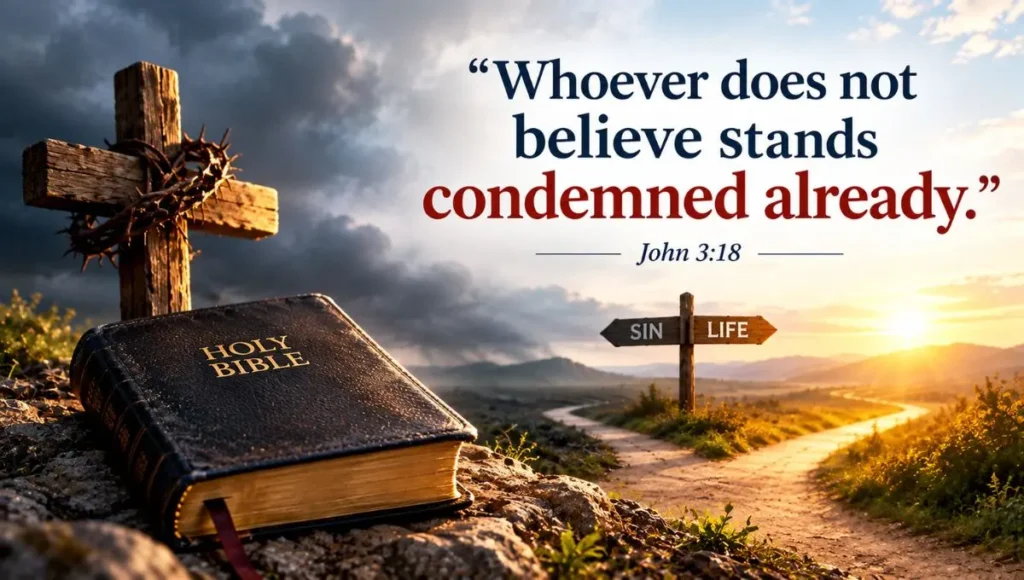
This comes two verses after John 3:16. The same chapter that promises eternal life explains the other side.
The verse shows the choice is already in motion. Unbelief is not neutral.
“The Lord is a jealous and avenging God.” — Nahum 1:2
The NIV continues, “the Lord takes vengeance and vents his wrath.” Biblical jealousy here is covenant faithfulness, similar to Exodus 34:14.
God’s justice is part of His love. A God who never judged evil would not be good.
Read Also: 444 Meaning in the Bible: Biblical Meaning, Symbolism & God’s Message
Why These Cold Verses Matter
The coldest Bible verses are not meant to produce fear alone. They aim for repentance, humility, and a real relationship with God. Most of them sit beside offers of grace, as seen in Romans 6:23, Hebrews 9:28, Joel 2:12–13, and Ezekiel 18:32.
| Theme | Key verses | Core message |
| Judgment | Matthew 7:23, Revelation 20:15, Hebrews 9:27 | Everyone answers to God |
| False faith | Matthew 7:21, Revelation 3:16 | Words and routine are not enough |
| Sin’s cost | Romans 6:23, Ezekiel 18:20, Galatians 6:7 | Choices have consequences |
| Human heart | Jeremiah 17:9, Proverbs 14:12 | Feelings can mislead |
| Priorities | Mark 8:36, Matthew 6:24, Matthew 10:37 | Christ comes first |
| Urgency | John 9:4, Proverbs 1:28 | Time is limited |
Frequently Asked Questions
What are some coldest Bible verses that are short?
Try “The soul who sins shall die” (Ezekiel 18:20) and “No one can serve two masters” (Matthew 6:24). “Many are called, but few are chosen” (Matthew 22:14) is also short.
What are the coldest Bible verses from Romans?
Romans 6:23 (“the wages of sin is death”) and Romans 2:6 (God repays each person according to what they have done) are among the most direct.
What are the coldest Bible verses for athletes?
John 9:4 on using the time we have, and Mark 8:36 on gaining the world but losing the soul, speak well to competitors.
What are the coldest Bible verses for men?
Matthew 6:24 on divided loyalty, Matthew 10:37 on putting Christ first, and Proverbs 14:12 on false confidence fit this question well.
What are the coldest verses in the Bible about revenge?
Nahum 1:2 says the Lord takes vengeance. Romans 12:19 says vengeance belongs to God, not to us.
What are some short Bible verses that go hard?
“I never knew you” (Matthew 7:23), “God cannot be mocked” (Galatians 6:7), and “There is no peace for the wicked” (Isaiah 48:22) are widely shared.
What are the coldest Bible verses on Reddit?
There is no official list, and threads change often. Verses like Matthew 7:23 and Revelation 3:16 are commonly called “cold” online.
What are Bible verses that hit hard about life?
Hebrews 9:27 on one life and then judgment, and Proverbs 14:12 on paths that seem right but fail, hit hard about how we live.
Conclusion
The coldest Bible verses are blunt because the truth sometimes has to be. Judgment, accountability, and urgency run through Scripture, yet so do mercy and grace. Almost every hard verse above sits close to an invitation to return to God.
Read them slowly, and let them test your own heart before anyone else’s. Do not settle for religious routine, half-hearted faith, or paths that only seem right.
Choose the narrow road while there is still daylight to walk it. And hold on to the promise of Romans 6:23: the free gift of God is eternal life in Christ Jesus our Lord.










1 thought on “37+ Coldest Bible Verses You Never Knew Existed”