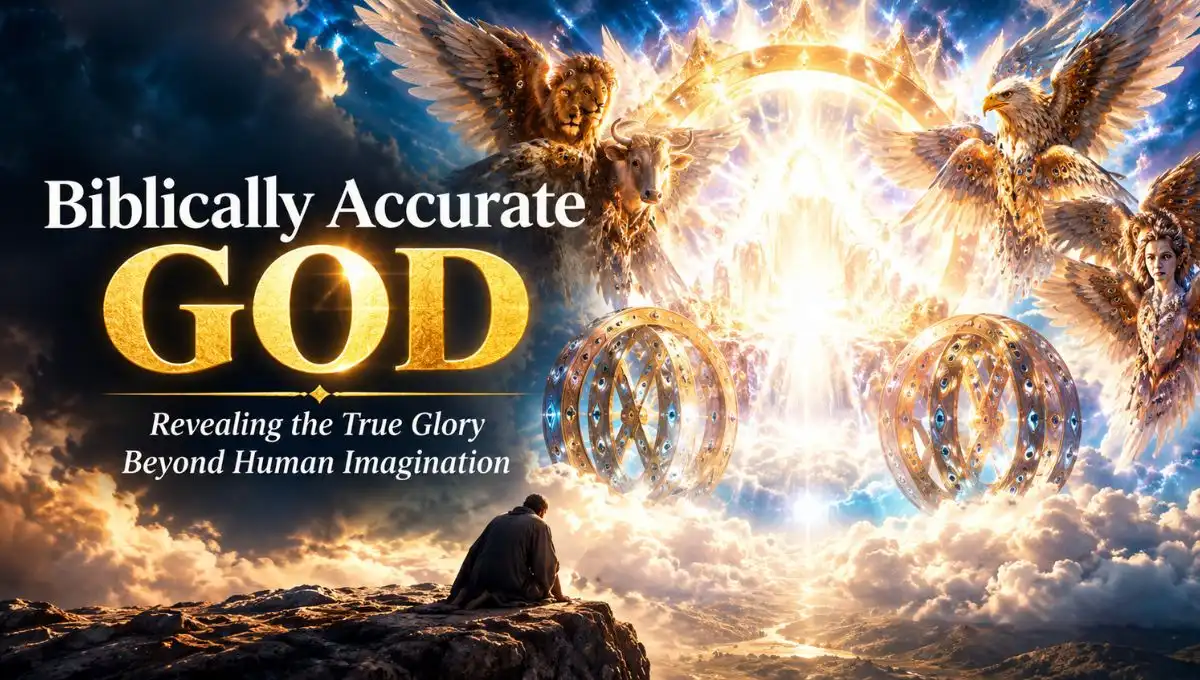
What does the Bible actually say about what God looks like? Rather than relying on Renaissance paintings or human imagination, Scripture presents a biblically accurate God through powerful visions, divine manifestations, and descriptions of His glory.
From radiant fire and overwhelming light to majestic heavenly appearances, the Bible reveals a God far beyond ordinary human understanding.
This exploration examines what Scripture says about God’s appearance, character, and divine presence. Discover the biblical descriptions of God, His attributes, and the ways He reveals Himself throughout the Old and New Testaments.
The Concept of a Biblically Accurate God
A biblically accurate God is God as Scripture presents Him, not as art, film, or internet culture imagines Him. The Bible says God is spirit (John 4:24), eternal, and invisible (1 Timothy 1:17), yet He speaks, acts, and draws near to people.
In this guide, you will learn:
- Who God is according to the Bible
- What His attributes mean
- What the visions of Isaiah, Ezekiel, Daniel, and John really describe
- How Jesus and the Trinity fit the picture
- How to avoid common misreadings
The Biblical Meaning of God
Scripture opens with God, not with an argument for Him. The Bible calls Him the one living and true God (Deuteronomy 6:4; Jeremiah 10:10). At the burning bush He gave His name as I AM (Exodus 3:14), pointing to His self-existence.
God as Creator and Sustainer
God made everything (Genesis 1:1) and keeps it going. Colossians 1:16-17 says all things were created through and for Christ, and are held together in Him. Hebrews 1:3 adds that He upholds the universe by His powerful word.
God’s Divine Nature in Scripture
God is spirit, eternal, and not dependent on anything. Acts 17:25 says He needs nothing from us, and John 5:26 says He has life in Himself. Theologians call this His aseity, or self-existence.
God’s Relationship With Humanity
Humans are made in God’s image (Genesis 1:27), and He enters covenants with His people (Genesis 15; Jeremiah 31:33). He is high above creation, yet near to the humble (Isaiah 57:15). In Jesus, He came to live among us (Matthew 1:23).
Read Also: 100+ Short Bible Verses: Powerful One-Line Scriptures for Quick Inspiration
Core Divine Attributes Revealed in Scripture
Theologians often sort God’s attributes into two groups. Incommunicable attributes belong to God alone, while communicable attributes are shared with us in a limited way.
Wayne Grudem lists independence, unchangeableness, eternity, omnipresence, and unity among the incommunicable ones. Louis Berkhof’s Systematic Theology uses the same basic split.
Essential Divine Attributes
| Attribute | Meaning | Key Verse |
| Omnipotence | All-powerful | Genesis 17:1; Jeremiah 32:17 |
| Omniscience | Knows everything | Psalm 139:1-4; 1 John 3:20 |
| Omnipresence | Present everywhere | Psalm 139:7-10; Jeremiah 23:23-24 |
| Eternity | Without beginning or end | Psalm 90:2 |
| Immutability | Unchanging in nature and promises | Malachi 3:6; James 1:17 |
| Holiness | Set apart, morally perfect | Isaiah 6:3 |
| Justice | Perfectly fair | Deuteronomy 32:4 |
| Love | Self-giving goodwill | 1 John 4:8 |
| Mercy | Compassion toward sinners | Exodus 34:6 |
| Faithfulness | Keeps His word | Lamentations 3:22-23 |
God’s Various Forms and Manifestations
God’s essence is spirit, but Scripture records many ways He made Himself known.
| Manifestation | Reference | What It Shows |
| Burning bush | Exodus 3:2-4 | Holiness and presence |
| Pillar of cloud and fire | Exodus 13:21 | Guidance and protection |
| Fire and smoke at Sinai | Exodus 19:16-19 | Majesty and awe |
| Gentle whisper | 1 Kings 19:11-13 | Nearness and care |
| Prophetic visions | Isaiah 6; Ezekiel 1; Daniel 7 | Glory and kingship |
| Jesus Christ | John 1:14 | God made visible |
Key Distinctions in Divine Manifestation
A manifestation is not God’s full being. Deuteronomy 4:12 says Israel heard a voice at Sinai but saw no form. What people saw were signs of His glory, and the fullest disclosure came in Jesus Christ (John 1:18).
Biblical Descriptions of God’s Appearance
The Bible never gives a physical portrait of God. It gives visions that communicate His character through light, fire, thrones, and sound.
Prophetic Visions of Divine Glory
| Vision | Reference | Key Imagery |
| Isaiah | Isaiah 6:1-5 | The Lord on a high throne, robe filling the temple, seraphim crying holy |
| Ezekiel | Ezekiel 1:26-28 | A throne like sapphire, a figure in fire and brightness, a rainbow glow |
| Daniel | Daniel 7:9-10 | The Ancient of Days, white clothing, fiery throne, countless attendants |
| John | Revelation 4:2-3 | A throne with jasper-like radiance and an emerald rainbow |
Ezekiel himself calls what he saw the appearance of the likeness of the glory of the Lord (Ezekiel 1:28). Even prophets spoke with careful, indirect language.
Progressive Revelation of God’s Character
God revealed Himself step by step:
- Creation shows His power and nature (Psalm 19:1; Romans 1:20)
- The patriarchs show His covenant faithfulness
- The prophets stress His holiness, justice, and mercy
- Jesus shows Him most fully (Hebrews 1:1-2)
Symbolic and Literal Descriptions in Scripture
The Bible speaks of God’s hand, eyes, and arm (Exodus 15:6; Psalm 34:15). These are figures of speech, since Numbers 23:19 says God is not a man. John Calvin (Institutes 1.13.1) described this as God adjusting His language to our level, like a nurse speaking to a child.
Why God Is Represented Through Symbols and Imagery
- Our minds are finite, and God is infinite
- Symbols show character, not anatomy: fire points to holiness, light to purity (1 John 1:5), a throne to kingship
- They guard against idolatry (Exodus 20:4)
God’s Glory and Holiness in Heavenly Visions
The people who saw these visions did not stay casual. Isaiah cried out in fear of his own sinfulness (Isaiah 6:5), Ezekiel fell on his face (Ezekiel 1:28), and John fell as though dead (Revelation 1:17).
The pattern repeats: awe, cleansing, then a calling. In Isaiah 6:6-7 a seraph touches his lips with a coal from the altar, and he is sent to speak for God.
Experiencing the Presence of God in Everyday Life
You do not need a vision to know God’s nearness. Scripture points to ordinary paths:
- Scripture: God speaks through His word (Psalm 119:105)
- Prayer: peace guards the praying heart (Philippians 4:6-7)
- The Holy Spirit: He assures believers they belong to God (Romans 8:14-16)
- Fellowship: Christ is present among His gathered people (Matthew 18:20)
- Creation: the heavens declare His glory (Psalm 19:1)
- Obedience: Jesus promises that He and the Father will dwell with those who love Him (John 14:23)
Jesus Christ: The Complete Revelation of God
Christ as the Perfect Image of God
Colossians 1:15 calls Jesus the image of the invisible God. John 1:18 says no one has seen God, but the Son has made Him known. Jesus is where the invisible God becomes knowable.
Jesus as God’s Exact Representation
Hebrews 1:3 says the Son is the radiance of God’s glory and the exact imprint of His nature. Jesus told Philip that whoever has seen Him has seen the Father (John 14:9). Colossians 2:9 says all the fullness of deity dwells in Him bodily.
Divine Attributes Displayed Through Jesus
| Attribute | Seen in Jesus | Reference |
| Power | Calms the storm | Mark 4:39-41 |
| Knowledge | Knows what is in people | John 2:25 |
| Compassion | Moved by the crowds | Matthew 9:36 |
| Mercy | Forgives the woman caught in sin | John 8:1-11 |
| Holiness | Cleanses the temple | John 2:13-16 |
| Love | Lays down His life | John 15:13 |
Jesus as the Key to Understanding Scripture
On the road to Emmaus, Jesus explained from Moses and the prophets what was written about Himself (Luke 24:27, 44). He also said the Scriptures testify of Him (John 5:39) and that He came to fulfill the Law (Matthew 5:17). Reading the Old Testament through Christ keeps the whole story together.
Essential Characteristics of the Biblically Accurate God
Divine Omnipotence and Omniscience
No purpose of God can be blocked (Job 42:2), and He declares the end from the beginning (Isaiah 46:10). Paul marvels at the depth of His wisdom and knowledge (Romans 11:33). God’s power always works in line with His character, so He cannot lie (Titus 1:2).
Perfect Holiness and Righteous Justice
God’s holiness is the basis for His call to His people (Leviticus 19:2). His justice is not harsh mood but perfect fairness (Deuteronomy 32:4). At the cross, God showed Himself both just and the one who justifies those who trust Christ (Romans 3:25-26).
Boundless Love and Abundant Mercy
God describes Himself as compassionate, gracious, slow to anger, and rich in steadfast love (Exodus 34:6-7). He removes our sins as far as east is from west (Psalm 103:8-12). His love is proven in Christ’s death for sinners (Romans 5:8; John 3:16).
The Triune Nature of God: Father, Son, and Spirit
Biblical Foundation for the Trinity
The word Trinity is not in the Bible, but the teaching is. Scripture insists there is one God (Deuteronomy 6:4) and also shows three who are called God and are distinct:
- The Father is God (1 Peter 1:2)
- The Son is God (John 1:1; John 20:28)
- The Spirit is God (Acts 5:3-4)
- All three appear together at Jesus’ baptism (Matthew 3:16-17) and in the Great Commission (Matthew 28:19)
The Nicene Creed (AD 325, expanded at Constantinople in AD 381) and the Westminster Confession (Chapter 2) both state this as three persons of one substance, power, and eternity.
God the Father’s Role
The Father plans and initiates salvation (Ephesians 1:3-5) and sends the Son (John 3:16). Jesus taught His followers to pray to Him as Father (Matthew 6:9).
God the Son’s Work
The eternal Word became flesh (John 1:14) and humbled Himself to die on the cross (Philippians 2:6-8). He is the one mediator between God and people (1 Timothy 2:5).
God the Holy Spirit’s Ministry
The Spirit convicts the world of sin (John 16:8), teaches and reminds believers (John 14:26), empowers witness (Acts 1:8), and prays for us when we cannot find words (Romans 8:26). He also produces fruit like love, joy, and peace (Galatians 5:22-23).
The Relational Character of God
Jesus spoke of the Father loving Him before the world began (John 17:24). Because God is love (1 John 4:8) within Himself, He did not need creation to have someone to love. His love is overflow, not need.
Implications of God’s Triune Nature
We come to the Father, through the Son, by the Spirit (Ephesians 2:18). That shapes worship, prayer, and salvation. Jesus also prayed that believers would share the unity He has with the Father (John 17:21).
Correcting Common Misconceptions About God
Why Distorted Views of God Develop
- Culture, movies, and art shape our mental picture
- Reading verses without their context
- Painful life experiences
- Relying on feelings over the whole Bible
Psalm 50:21 shows this is an old problem: people assume God must be just like them.
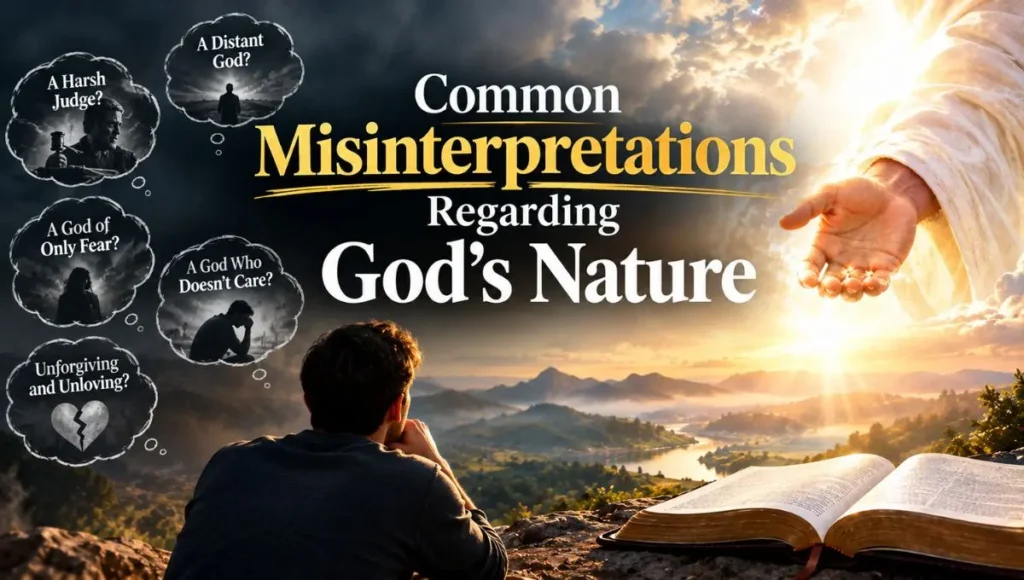
False Images That Misrepresent God
| Distortion | Why It Falls Short | Verse |
| Only angry and judging | Ignores His mercy | Psalm 103:8 |
| Distant and uninvolved | Ignores His nearness | Acts 17:27 |
| Permissive and soft | Ignores His holiness | Habakkuk 1:13 |
| An impersonal force | Ignores that He speaks and loves | Exodus 3:14-15 |
| A bearded man in the clouds | Ignores that He is spirit | John 4:24 |
How Scripture Corrects Our Understanding
- Read each passage in its full context
- Let clear passages explain unclear ones
- Read everything through Christ
- Compare your view with historic creeds
- Pray for the Spirit’s help
Scripture is useful for teaching and correction (2 Timothy 3:16-17), and the Bereans are praised for checking everything against it (Acts 17:11).
Read Also: 150+ Bible Verses for a Sister to Make Her Feel Loved, Blessed & Cherished
Biblically Accurate God and Biblically Accurate Angels
Popular culture often mixes God and angels together. The Bible keeps them clearly apart: God is Creator, angels are created.
The Difference Between God and Angels
Psalm 148:2-5 says angels were created at God’s command, and Colossians 1:16 includes thrones and powers among created things. When John tried to worship an angel, the angel stopped him and said to worship God (Revelation 22:8-9).
Differences in Nature, Authority, and Role
| Area | God | Angels |
| Origin | Uncreated, eternal | Created (Psalm 148:5) |
| Presence | Everywhere (Jeremiah 23:24) | In one place at a time |
| Knowledge | All-knowing | Limited (Matthew 24:36) |
| Worship | Receives it | Gives it (Hebrews 1:6) |
| Role | Sovereign King | Messengers and servants (Hebrews 1:14) |
Reconciling Old and New Testament Portraits of God
Progressive Revelation Explained
God did not change; our view of Him grew clearer. Hebrews 1:1-2 says God spoke in many ways through the prophets and then fully through His Son. It is like dawn moving toward full daylight.
God’s Consistent Character Throughout Scripture
The same character shows in both Testaments. Exodus 34:6 describes God as merciful and gracious, and Jonah 4:2 repeats it. Malachi 3:6 says God does not change, and Hebrews 13:8 says the same of Jesus.
Divine Judgment Across Both Testaments
Judgment appears in the Old Testament (the Flood, Genesis 6) and the New (Acts 5; Revelation 20:11-15). Mercy appears in both too: Nineveh was spared (Jonah 3:10), and Paul says kindness is meant to lead people to repentance (Romans 2:4). God takes no pleasure in the death of the wicked (Ezekiel 33:11).
Christ’s Interpretation of Difficult Passages
Jesus often deepened the Law instead of discarding it. He taught that anger is a root of murder (Matthew 5:21-22), summed up the Law as love for God and neighbor (Matthew 22:37-40), and reminded people that God desires mercy over sacrifice (Matthew 12:7).
Unity of God’s Redemptive Plan
The plan begins with a promise in Genesis 3:15 and widens in Genesis 12:3. It looks ahead in Isaiah 53 and ends with God dwelling with His people in Revelation 21:3.
Common Misinterpretations Regarding God’s Nature
Balancing Divine Love and Justice
Love and justice are not rivals. At the cross, God’s justice dealt with sin and His love paid the price (Romans 3:26). Psalm 85:10 pictures mercy and truth meeting together.
Understanding Sovereignty and Human Responsibility
Scripture teaches both. Acts 2:23 says Jesus was handed over by God’s plan and also killed by lawless men. Joseph tells his brothers that they meant evil but God meant it for good (Genesis 50:20). Paul tells believers to work out their salvation because God is working in them (Philippians 2:12-13).
Christians differ on how these fit together, but all historic traditions affirm both.
The Paradox of Divine Control and Human Choice
This is a mystery, not a contradiction. Deuteronomy 29:29 reminds us that some things belong to God alone. Proverbs 16:9 says people plan their way, but the Lord directs their steps.
Key Bible Verses That Reveal God’s Nature
Old Testament Verses About God
- Genesis 1:1: God is Creator
- Exodus 3:14: God is self-existent, I AM
- Exodus 34:6-7: God is merciful and just
- Deuteronomy 6:4: The Lord is one
- Psalm 90:2: God is eternal
- Psalm 139:7-10: God is everywhere
- Isaiah 6:3: God is holy
- Isaiah 40:28: God never tires
- Isaiah 55:8-9: God’s ways are higher than ours
- Malachi 3:6: God does not change
New Testament Verses About God
- John 1:1, 14: The Word is God and became flesh
- John 4:24: God is spirit
- John 14:9: Jesus reveals the Father
- Romans 11:33-36: God’s wisdom is beyond tracing
- 2 Corinthians 13:14: Father, Son, and Spirit together
- Colossians 1:15-17: Christ is the image of God and sustains all
- Hebrews 1:3: Christ is the exact imprint of God’s nature
- 1 John 4:8, 16: God is love
- Revelation 4:8: God is holy and eternal
- Revelation 21:3: God dwells with His people
Verses About God’s Character and Attributes
- Psalm 145:8-9: Gracious, compassionate, good to all
- Deuteronomy 32:4: Faithful and just
- Numbers 23:19: God does not lie or change His mind lightly
- Lamentations 3:22-23: His mercies are new each morning
- Titus 1:2: God cannot lie
- James 1:17: Every good gift comes from Him
- 1 John 1:5: God is light
Why Biblical Accuracy Matters in Understanding God
Knowing God as He Truly Is
Wrong ideas about God lead to wrong worship. Scripture is the reliable source because God Himself inspired it (2 Timothy 3:16). J. I. Packer’s Knowing God makes the same point: knowing about God must lead to knowing Him.
Guiding Faith and Daily Decisions
What you believe about God shapes how you handle fear, money, grief, and ethics. A God who is good and sovereign gives steady footing (Romans 8:28).
Building Authentic Personal Relationship
Relationships rest on truth. Jesus said true worshipers worship in spirit and in truth (John 4:23-24).
Countering False Representations
Knowing Scripture protects against false teaching (Ephesians 4:14). It is easier to spot a counterfeit when you know the original well.
Life Transformation Through Knowing God’s True Nature
From Fear to Confident Assurance
Grace opens the way to approach God boldly (Hebrews 4:16). Perfect love drives out fear (1 John 4:18).
From Religious Performance to Grace-Based Rest
Salvation is a gift, not a wage (Ephesians 2:8-9). Jesus invites tired people to come and rest (Matthew 11:28).
Worship Marked by Reverence and Intimacy
Hebrews 12:28-29 calls for worship with reverence and awe. Romans 8:15 lets us call God Father. A healthy faith holds both together. A. W. Tozer’s The Knowledge of the Holy is a classic on this balance.
Prayer Grounded in Trust
When you know God is good and listens, prayer shifts from a performance to a conversation (Matthew 7:7-11; 1 John 5:14).
Living with Divine Purpose and Hope
Believers are called to good works prepared for them (Ephesians 2:10) and given a living hope (1 Peter 1:3). That brings renewed purpose, lasting hope, and spiritual growth.
Practical Steps to Learn About the Biblically Accurate God
Systematic Study of Biblical Texts
- Pick one attribute and trace it through the Bible
- Use cross-references to follow the theme
- Read the full chapter, not one verse
- Add trusted books: Grudem’s Systematic Theology, Berkhof’s Systematic Theology, Packer’s Knowing God, and Tozer’s The Knowledge of the Holy
Seeking Divine Guidance Through Prayer
- Pray before you read, asking for understanding (Psalm 119:18)
- Keep a short journal of what you learn
- Meditate slowly on one verse a day (Psalm 1:2)
Community and Fellowship’s Vital Role
- Join a Bible study group
- Listen to faithful church teaching
- Talk with mature believers or a mentor (Proverbs 27:17)
Read Also: 51 Bible Verses About Baseball and God’s Lessons in the Game
The Biblical Picture of God
Putting it together, the Bible’s God is:
- One God in three persons, Father, Son, and Spirit
- Spirit, eternal, and beyond physical form
- Perfectly holy, just, loving, and merciful
- Revealed through symbols and visions, and most fully in Jesus Christ
- Near to His people, yet far greater than our imagination
Frequently Asked Questions
Who is the biblically accurate God the Father?
He is the first person of the Trinity, an eternal, holy, loving Father who sends the Son (John 3:16). He is spirit, not a human figure.
What is a biblically accurate angel?
An angel is a created spirit messenger who serves God (Hebrews 1:14). They often appear as ordinary men (Hebrews 13:2) and only sometimes in awe-inspiring form.
What is biblically accurate heaven like?
Heaven is God’s dwelling, and the future new creation brings no more tears, death, or pain (Revelation 21:1-4). God lives among His people.
What does biblical accurate Jesus mean?
It means Jesus as the Gospels present Him: fully God and fully man, a Jewish Galilean with an ordinary appearance (Isaiah 53:2), now glorified (Revelation 1:12-16).
What is a biblically accurate demon?
Demons are fallen angels who followed Satan in rebellion (Revelation 12:7-9; Jude 6). They deceive, but Christ has authority over them (Luke 10:17-20). The Bible gives no horror-movie descriptions.
What is a biblically accurate seraphim?
Seraphim are six-winged beings around God’s throne who cry holy (Isaiah 6:2-3). The name comes from a Hebrew root meaning to burn.
What does God look like?
God is spirit and has no physical body (John 4:24). Scripture reveals Him through symbols and glory, and fully through Jesus.
What does God look like according to the Bible?
The Bible shows His glory through throne visions (Ezekiel 1:26-28; Daniel 7:9), but says no one has seen Him fully (1 Timothy 6:16). Believers will see Him one day (1 John 3:2).
Conclusion
The biblically accurate God is far greater than any image we can draw. He is holy, loving, just, and merciful, and He has made Himself known through creation, the prophets, and most fully through Jesus Christ. Knowing Him as Scripture presents Him changes how we worship, pray, and live.
The best next step is simple: open the Bible, pick one passage from this guide, and read it slowly.





1 thought on “Biblically Accurate God: Revealing the True Glory Beyond Human Imagination”