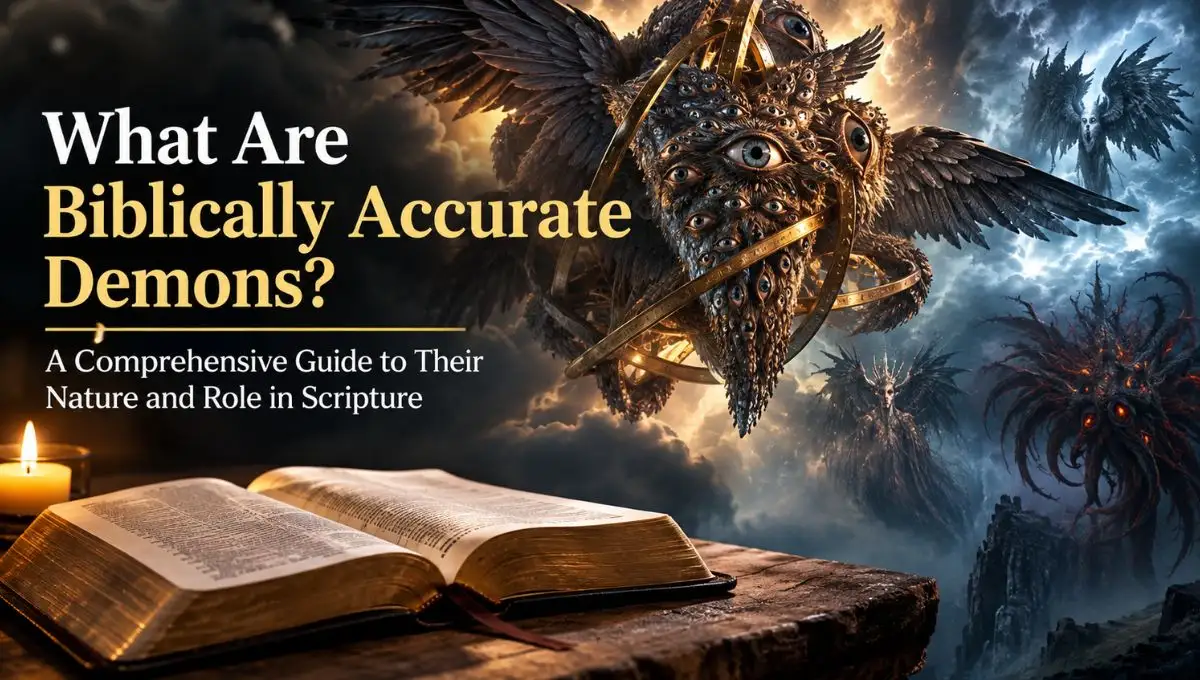
Biblically accurate demons are far different from the frightening creatures portrayed in movies, games, and popular culture. The Bible presents demons as spiritual beings opposed to God, operating under limits established by His authority.
Understanding what Scripture says about their nature, origins, activities, and ultimate destiny can help separate biblical truth from cultural myths.
In this comprehensive guide, we’ll explore biblically accurate demons through key passages from the Old and New Testaments, examine their characteristics and roles, and explain how Christians should understand spiritual warfare.
Discover what the Bible actually teaches about demons and the authority believers have through Jesus Christ.
Understanding Biblical Terminology: Biblically Accurate Hebrew and Greek Words for Demons
Before asking what demons are, we need to know what the Bible calls them. Translation choices have shaped much of the confusion.
Hebrew Terms for Evil Spirits
The Hebrew Bible has no single, tidy “demon” vocabulary. It uses a handful of terms, and some are debated.
Both shedim passages involve sacrifice to false gods. The Greek Old Testament translated shedim with the word daimoniois.
Translations vary a lot here. Different English versions render these Hebrew words as “demons,” “goat-demons,” or “devils.”
Some scholars also note that the Old Testament often treats false gods as having no real existence. Paul later says pagan sacrifices are offered to demons (1 Cor. 10:20).
Greek Terms in the New Testament
The New Testament vocabulary is more consistent.
- Daimonion (demon): used over sixty times. In earlier Greek, daimonion could simply mean a god or divine being.
- Pneuma akatharton (unclean spirit): appears thirteen times in Mark.
- Diabolos (devil): comes from a verb meaning “to slander” or “accuse.”
- Satanas (Satan): the Hebrew word for “adversary” or “accuser.”
The Gospels treat “demon,” “evil spirit,” and “unclean spirit” as interchangeable expressions.
One KJV problem: the King James Version translates both diabolos and daimonion as “devil,” which blurs two different words.
Why This Linguistic Understanding Matters
- It stops us from reading later imagery into old words. The Hebrew terms do not describe horned monsters.
- It shows how translation shapes belief. “Devils,” “demons,” and “goat idols” can all translate similar words.
- It encourages humility. Where the text is unclear, we should say so.
Complete Biblical Taxonomy of Demons and Evil Entities
Scripture never gives an official “org chart” of evil. The seven categories below are a study aid that scholars and teachers commonly use, not a list the Bible itself provides.
| # | Category | Examples | How Clear Is It? |
| 1 | NT unclean spirits | Legion, spirits cast out by Jesus | Explicit |
| 2 | Named fallen angels | Abaddon; Azazel; Nephilim (debated) | Mixed |
| 3 | Hebrew OT demons | Shedim, se’irim | Explicit but brief |
| 4 | Pagan gods linked to demons | Baal, Beelzebub, Molech | Partly explicit (1 Cor. 10:20) |
| 5 | Chaos monsters | Leviathan, Behemoth, Rahab | Symbolic, not demons strictly |
| 6 | Ambiguous entities | The “destroyer” at Passover | Debated |
| 7 | Satan | Devil, serpent, dragon | Explicit |
Read Also: 150+ Bible Verses for a Sister to Make Her Feel Loved, Blessed & Cherished
Biblical Demons vs. Fallen Angels: Key Differences Explained
Are demons and fallen angels the same? Christians have answered in three main ways.
The Catholic Church teaches that the devil and other demons were created good and became evil by their own choice. Many Protestants agree on the basic picture.
What can we say confidently?
- Demons are personal, malevolent spiritual beings opposed to God.
- They are created, not eternal.
- Scripture does not give a complete origin story.
Biblically Accurate Demons in the Old and New Testament
New Testament Demons (Unclean Spirits)
Demons appear constantly in the Gospels. The Synoptic Gospels contain fifty-three references to daimonia.
What the New Testament shows them doing:
- Afflicting people physically and mentally (Mark 5:1-5; Matt. 17:18).
- Recognizing Jesus as God’s Holy One (Mark 1:24).
- Entering animals when cast out (Luke 8:32-33).
- Being driven out by a simple command (Mark 1:25-26).
The Gospels also separate demonic affliction from ordinary illness. In Matthew 4:24, the demonized appear in a list alongside the sick, epileptic, and paralyzed.
Named Fallen Angels
The Nephilim (Genesis 6:1-4). Who were the “sons of God”? There are three main views.
| View | Sons of God Are… | Notes |
| Angelic | Fallen angels | Favored by Justin Martyr, Irenaeus, Clement of Alexandria, and Tertullian |
| Sethite | Descendants of Seth | Chrysostom and Augustine held this view |
| Royal | Human kings or rulers | A minority reading |
The word “Nephilim” appears only twice: in Genesis 6 and Numbers 13:33. Faithful interpreters disagree here.
Azazel. Scholars suggest at least four meanings: the scapegoat itself, a place, an abstract idea of “removal,” or a demonic being. The Book of Enoch, which is not Scripture, presents Azazel as a leader of fallen angels.
Abaddon (Apollyon). The name means “destruction” in Hebrew and “Destroyer” in Greek. In Revelation 9:11, he rules an army of locusts. His exact identity is left open.
Hebrew Demons of the Old Testament
The shedim are named only in contexts of idolatry and child sacrifice (Ps. 106:37). The se’irim are linked with goats and wilderness places.
Later Jewish and Christian writers developed these ideas. Se’irim have often been compared to satyrs, and early Jewish translations understood them as demons.
Pagan Gods Presented as Demons
Israel’s neighbors worshiped Baal (a title meaning “lord”), Molech, Dagon, and others. Paul says idol sacrifices are offered “to demons and not to God” (1 Cor. 10:20).
Beelzebub shows how a name shifted over time.
- In 2 Kings 1:2, King Ahaziah consulted Baal-zebub, the god of Ekron.
- By Jesus’ day, the Pharisees accused Him of casting out demons by “Beelzebul, the prince of demons” (Matt. 12:24).
- Jesus’ reply links this figure with Satan (Matt. 12:26).
Scholars also note the spellings differ. “Beelzebub” is usually “Lord of the Flies,” while “Beelzebul” is often read as “exalted master” or “lord of the heights.”
Chaos Monsters
Leviathan (Job 41; Isa. 27:1), Behemoth (Job 40), and Rahab (Isa. 51:9) are not demons in the strict sense. They are symbols of chaos and raw power, and Scripture shows God ruling over all of them.
Read Also: 100+ Short Bible Verses: Powerful One-Line Scriptures for Quick Inspiration
Biblically Accurate Understanding of Ambiguous Entities and Satan
Ambiguous Entities
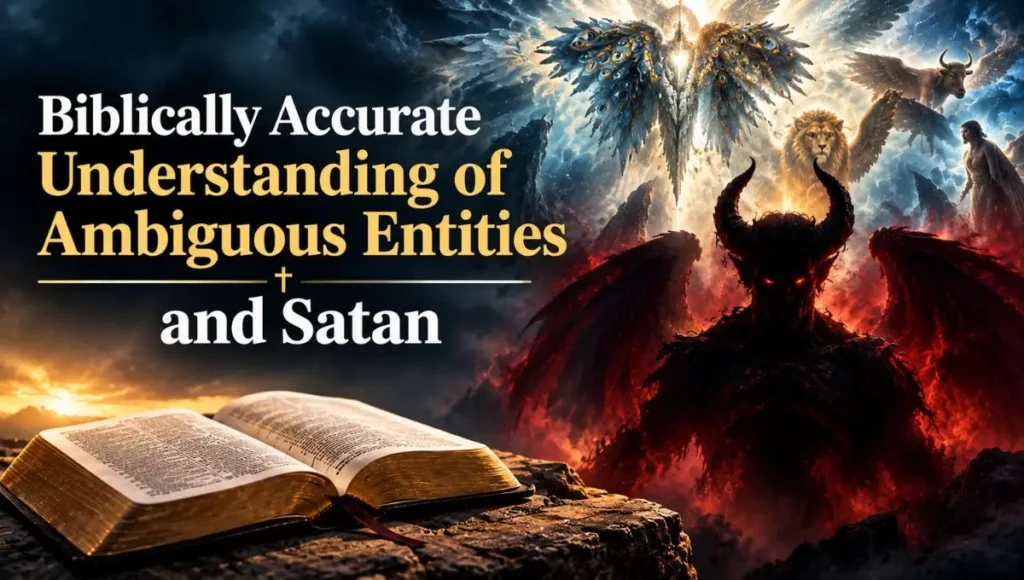
Some figures act destructively but under God’s command. At the Passover, God keeps “the destroyer” from entering marked homes (Exod. 12:23). An angel carries out judgment after David’s census (2 Sam. 24:15-17).
These beings do not rebel. They carry out judgment on God’s orders.
Satan – Prince of Demons
Satan is the leader of evil forces in Scripture. His titles describe his work:
| Title | Meaning or Source |
| Satan | Hebrew for “adversary, accuser” (Job 1:6) |
| The devil | From Greek diabolos, “slanderer” |
| Serpent/dragon | Revelation 12:9 |
| Ruler of this world | John 14:30 |
| Beelzebul | Matt. 12:24 |
Satan’s Origin and Fall
This is a place where interpreters differ. Many Christians read Isaiah 14 and Ezekiel 28 as describing Satan’s fall. Yet Isaiah 14 is explicitly a taunt against the king of Babylon, and Ezekiel 28 addresses the king of Tyre.
Two approaches exist:
- Primary reference only to the kings, using hyperbolic language.
- Layered meaning, where the kings point to a deeper spiritual force behind them. Some scholars link the near and distant meanings in both passages.
On the name Lucifer: It comes from the Latin Vulgate’s rendering of the Hebrew helel. Tertullian and Origen were among the early writers who applied these passages to Satan.
Other texts (Luke 10:18; Rev. 12:7-9; 1 Tim. 3:6) support the traditional picture of rebellion through pride.
Satan’s Nature and Limitations
- He is a creature, not a rival god.
- He needs permission to harm Job (Job 1:12; 2:6).
- His power is real but not infinite, and his actions are permitted by divine providence.
- His main method is disguise (2 Cor. 11:14).
- His defeat is certain (Col. 2:15; Rev. 20:10).
The Two Physical Descriptions in Scripture
Many teachers say demons receive only two physical descriptions. The truth is that Scripture gives almost none, and these two are the nearest candidates.
- Se’irim (“hairy ones”). This comes from word roots, and scholars warn that building a physical appearance from etymology is unsound.
- The locusts of Revelation 9. This is apocalyptic imagery, symbolic by nature.
Compare this with heavenly beings. Ezekiel describes cherubim with four faces and wheels covered in eyes, and Isaiah 6:2 describes seraphim with six wings. Scripture cares more about what demons do than how they look.
How Christian Demonology Developed Through Extrabiblical Sources
The Book of Enoch’s Massive Influence
- Its oldest sections date to roughly 300-200 BC.
- Jude 14-15 cites 1 Enoch 1:9.
- Only the Ethiopian and Eritrean Orthodox churches (and Beta Israel) treat it as canonical.
- It describes the Watchers who fathered the Nephilim, and it names Azazel as chief among those who taught humans forbidden things.
A quotation in Jude does not settle whether Jude saw the whole book as Scripture. Scholars like David leave that question open.
Church Fathers’ Interpretive Contributions
Early Christian writers split on key questions. On Genesis 6, several early fathers favored the angelic reading, while Chrysostom and Augustine favored the Sethite view. Origen and Tertullian helped shape the idea that Satan fell from heaven.
Medieval Demonology’s Elaborations
By the Middle Ages, demonology had grown elaborate.
- In 1467, Alonso de Espina’s figures for the fallen angels ran past 133 million, though sources vary on the exact total.
- Johann Weyer’s demon catalog (1583) was later expanded in the Lesser Key of Solomon.
None of this has scriptural support.
Literary Influence: Dante and Milton
Dante’s Inferno (c. 1320) pictured Satan frozen at the center of hell. Milton’s Paradise Lost (1667) made him a tragic, eloquent rebel. Both shaped how Western readers imagine the devil far more than the Bible did.
Why This Historical Context Matters
- It separates Scripture from tradition.
- It guards against superstition and fear.
- It brings us back to what God actually revealed.
Distinguishing Demonic Possession from Oppression in Biblically Accurate Terms
Defining Possession vs. Oppression
| Possession (Indwelling) | Oppression (External) | |
| Location | Inside the person | Outside, pressing in |
| Control | Will overridden in some areas | Will remains the person’s own |
| Typical signs | Loss of self-control, voice change, violent self-harm | Persistent temptation, accusation, discouragement |
| Example | Mark 5:1-13 | Job 1-2; 1 Pet. 5:8 |
One note on terms: the Greek verb behind “possessed” is daimonizomai. Wayne Grudem argues that “possessed” is not really reflected in the Greek, and “demonized” is more precise.
Can Christians Be Possessed?
Christians disagree here.
The majority evangelical view: no. Most evangelical scholars and pastors hold that a believer indwelt by the Holy Spirit cannot be possessed. Key texts are 1 Cor. 6:19-20 and 1 John 4:4.
A minority view: possible in some form. Fred Dickason’s book on the subject presents both biblical evidence against and for the demonization of believers. Merrill Unger changed his mind and argued that believers can be demonized under certain conditions.
The Catholic view. True possession is considered rare.
Many agree on this much: demons can harass and tempt believers, and God’s people should not live in fear.
Can Christians Be Oppressed?
Yes. Peter warns believers that the adversary “prowls around” (1 Pet. 5:8), and Paul describes a struggle “against the spiritual forces of evil” (Eph. 6:12). Paul’s “thorn in the flesh” is called a messenger of Satan (2 Cor. 12:7).
Forms of Demonic Oppression Against Believers
| Area | What It May Look Like |
| Spiritual | Doubt, confusion, unusual temptation |
| Emotional | Fear, accusation, hopelessness |
| Circumstantial | Obstacles to ministry or witness |
| Physical | Affliction permitted by God (Job 2:6) |
An important caution. Not every struggle is demonic. Anxiety, depression, grief, and illness have natural causes and deserve medical care. A believer facing these should see a doctor or counselor and seek pastoral support, rather than treating them as purely spiritual attacks.
If someone is thinking of self-harm, they should contact local emergency services or a trusted person right away.
Protection and Response for Believers
- Submit to God first (James 4:7).
- Put on the armor of God daily (Eph. 6:10-18).
- Store Scripture in your heart (Ps. 119:11).
- Stay connected to a church community (James 5:14-16).
- Seek wise counsel when struggles persist.
Clarifying Contemporary Misunderstandings: Pop Culture vs. Biblical Truth
Physical Appearance: Fiction vs. Scripture
| Pop Culture | Scripture |
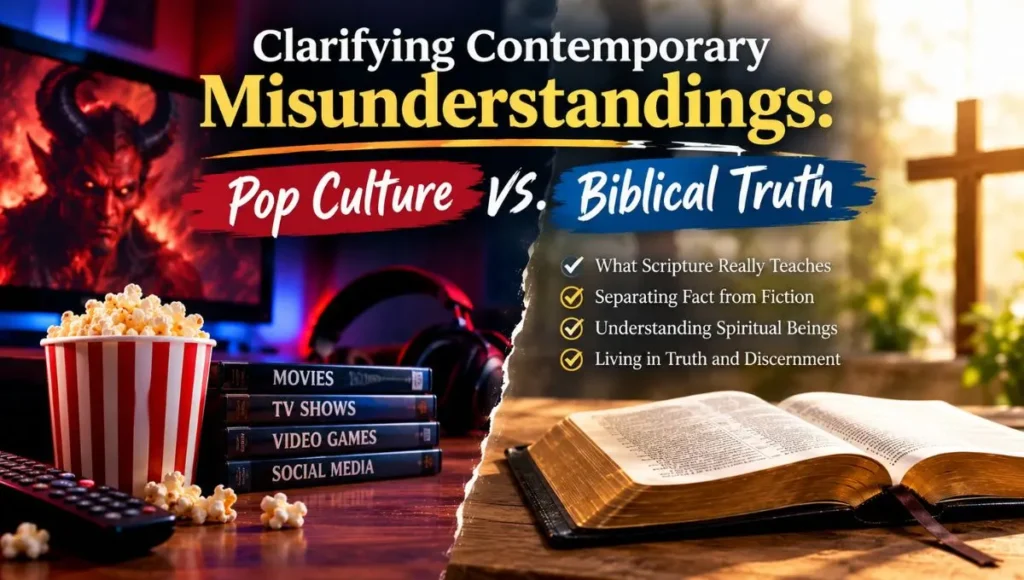
| Red skin, horns, tail | No such description |
| Pitchfork | Not mentioned |
| Cloven hooves | Possibly from se’irim (goat) imagery and Greek satyrs |
| Bat wings | Medieval art |
Researchers have traced the devil’s hooves and horns to older traditions. Alexander Kulik’s 2013 article in Numen studies how this imagery arose.
Power Level: Exaggeration vs. Reality
- Demons are created, not divine.
- They cannot act outside God’s limits (Job 1:12).
- They fear Jesus (Mark 1:24).
- They are defeated (Col. 2:15).
Demonic Possession: Hollywood vs. Scripture
Films favor elaborate rituals and spectacle. In the Gospels, Jesus drives out spirits with a short command (Mark 1:25-26). Authority comes from Christ, not from technique.
Satan’s Role: Misconceptions Clarified
Satan does not rule hell. Jesus says hell was prepared “for the devil, and his angels” (Matt. 25:41), and Revelation 20:10 shows Satan thrown into the lake of fire as a prisoner.
Why These Misunderstandings Matter
- They create needless fear.
- They distract from Christ.
- They make skeptics dismiss a caricature instead of the biblical teaching.
Read Also: 444 Meaning in the Bible: Biblical Meaning, Symbolism & God’s Message
Spiritual Warfare: Practical Protection and Authority
Scripture treats spiritual conflict as real but never as the main event. The center of the Bible’s message is Christ. The practical pattern is simple:
- Know the truth.
- Stay near God.
- Resist temptation.
- Lean on the church.
Biblical Demonology and the Authority of Jesus Christ
Everything the Bible says about demons points back to the authority of Jesus. He drives out demons by the Spirit of God, and Jesus explains that this shows the kingdom has arrived (Matt. 12:28).
The Reality of Spiritual Warfare
Paul says our struggle is not “against flesh and blood” (Eph. 6:12). We fight from Christ’s victory, not for it (Col. 2:15).
The Armor of God (Ephesians 6:13-18)
| Piece | Meaning |
| Belt of truth | Honesty and sound teaching |
| Breastplate of righteousness | Right standing and holy living |
| Shoes of the gospel of peace | Readiness to stand |
| Shield of faith | Trusting God’s promises |
| Helmet of salvation | Assurance of rescue |
| Sword of the Spirit | The word of God |
| Prayer (v. 18) | Constant dependence on God |
Paul names six pieces of armor and adds prayer as the way they are used.
Authority Over Demons
- Jesus gave His followers authority (Luke 10:19).
- That authority is in His name, not in personal power (Acts 16:18).
- It requires real faith: in Acts 19:13-16, the sons of Sceva tried to use Jesus’ name without knowing Him and were overpowered.
- Mark 9:29 links hard cases to prayer. Some manuscripts add “and fasting.”
Resisting Satan’s Schemes
James 4:7 gives the order: “Submit yourselves therefore to God. Resist the devil, and he will flee from you.” Submission comes first. Resistance without submission is just effort.
Closing Open Doors
Scripture mentions several things that can give the enemy a foothold:
- Unrepented sin (Eph. 4:26-27).
- Unforgiveness (2 Cor. 2:10-11).
- Occult practices, which new believers in Ephesus renounced publicly (Acts 19:19).
The biblical response is confession, forgiveness, and repentance, with the support of mature believers. It is not fear.
Frequently Asked Questions
What is a biblically accurate devil?
Scripture presents Satan as a created angel who became the adversary and accuser, not a red, horned figure. He disguises himself as “an angel of light” (2 Cor. 11:14).
What are biblically accurate demons and angels?
Demons are evil spirits in rebellion against God, while angels are His messengers. Demons are rarely described physically, but cherubim and seraphim have strange, awe-inspiring forms (Ezek. 1; Isa. 6).
What do biblically accurate demons look like?
The Bible rarely says. Most demons in the Gospels are unseen and known by their effects, while the Revelation 9 locusts are symbolic imagery.
Are biblically accurate demons beautiful?
Scripture ties beauty to deception, not to their nature. Satan “disguises himself as an angel of light” (2 Cor. 11:14), so appearance proves nothing.
What does biblically accurate Jesus mean?
It means going back to Scripture instead of artistic tradition. Isaiah 53:2 says He had no striking appearance, and Revelation 1:12-16 is a symbolic vision, not a portrait.
What is the list of demons in the Bible?
The Bible names few: Legion (Mark 5:9), Beelzebul (Matt. 12:24), Abaddon/Apollyon (Rev. 9:11), and Satan as chief. Azazel (Lev. 16) is debated.
What are the names of demons in the Bible and what do they do?
Satan accuses and opposes; Beelzebul is called “prince of demons”; Legion afflicted one man, and Abaddon/Apollyon (“Destroyer”) leads the locusts of Revelation 9.
What are the names of demons in the Bible KJV?
The KJV often renders them “devils” (Deut. 32:17; Ps. 106:37). Names it keeps include Beelzebub, Legion, Abaddon, Apollyon, Belial, and Satan.
Conclusion
Biblically accurate demons are less cinematic and more sobering than popular culture suggests. Scripture shows them as real, deceptive spiritual beings who oppose God’s people, yet they are created, limited, and already defeated through Christ.
Learn the original Hebrew and Greek terms, keep Scripture separate from tradition, and hold debated questions with humility. Not every struggle is demonic, so combine prayer with medical and pastoral help.
Most importantly, rest in Christ’s authority rather than fear. When you study biblically accurate demons through the Bible itself, your focus stays where it belongs: on Jesus.





1 thought on “What Are Biblically Accurate Demons? A Comprehensive Guide to Their Nature and Role in Scripture”