The biblically accurate Lucifer is often misunderstood because popular culture, medieval traditions, and modern artwork have shaped ideas that go beyond what Scripture actually teaches.
The Bible presents a more complex picture, especially when examining passages associated with the “morning star,” pride, rebellion, and spiritual downfall. By exploring the Hebrew language, biblical context, and historical interpretation, we can better understand where the name Lucifer came from and how it became connected with Satan.
This guide examines what Scripture reveals about Lucifer, separates biblical truth from common misconceptions, and explains the theological meaning behind his fall, rebellion, and opposition to God.
Biblically Accurate Understanding of Lucifer’s Identity
The name “Lucifer” is Latin and entered English Bibles through translation. Its meaning and its biblical context are different from popular belief.
Common Misconceptions About Lucifer in Modern Culture
- “Lucifer” is Satan’s original angelic name. The Bible never says this.
- He has horns, a tail, and red skin. These traits come from later folklore, medieval art, and the theatre.
- Hell is his kingdom, where he rules. Scripture presents hell as a place of judgment prepared for him, not a realm he governs (Matthew 25:41).
- Isaiah 14 is a simple history of Satan’s fall. The chapter opens as a taunt against a human king.
What Scripture Actually Reveals About Lucifer
The name appears only in Isaiah 14:12. In a 1968 study in the Journal of the Evangelical Theological Society, Robert Alden noted that the Bible mentions Lucifer only once.
The context is a “taunt” Isaiah tells Israel to sing against the king of Babylon (Isaiah 14:4). The passage describes this king in cosmic language and then brings him down to Sheol. Bible handbooks used by translators read the “fall from heaven” as a figure of speech for his downfall.
Ezekiel 28:11–19 is often read alongside it. That passage is a lament over the king of Tyre who is described as a guardian cherub in Eden. Scholars agree it is addressed to a human ruler. They disagree on whether its language reaches beyond him.
The Hebrew Original: Helel and Its True Meaning
The Hebrew phrase is helel ben shachar. It means “shining one, son of the dawn.” Lee Fields, a Hebrew scholar writing for Zondervan Academic, notes that helel occurs only here in the Hebrew Bible and comes from a verb meaning “to shine.” Most interpreters connect the phrase with Venus, the morning star.
| Element | Meaning |
| helel | “shining one,” from a root meaning “to shine” |
| ben | “son of” |
| shachar | “dawn” or “morning” |
| Likely image | Venus as the morning star |
Jerome’s Latin Vulgate and the Birth of “Lucifer”
The Greek Septuagint rendered helel as heōsphoros, “dawn-bringer.” Jerome’s Latin Vulgate used lucifer, from lux (light) and ferre (to bear). Both Greek and Latin words are names for the morning star.
In the Vulgate, Lucifer is also used for Christ as the morning star in 2 Peter 1:19. That shows the word was not originally a name for the devil.
King James Translation and English Christian Tradition
The KJV followed the Vulgate and kept “Lucifer” as a name. Most modern versions do not. One translator’s handbook on Isaiah says translators should not use “Lucifer” and should use “Day Star” or a similar phrase.
| Version | Isaiah 14:12 rendering |
| Hebrew | helel ben shachar |
| Septuagint | heōsphoros (dawn-bringer) |
| Vulgate | Lucifer |
| KJV / NKJV | Lucifer, son of the morning |
| NIV | morning star, son of the dawn |
| ESV | Day Star, son of Dawn |
Read Also: 444 Meaning in the Bible: Biblical Meaning, Symbolism & God’s Message
Biblically Accurate Description of Lucifer’s Appearance
Scripture gives almost no physical description of the fallen figure. The imagery it does offer is about beauty, light, and splendor.
Lucifer’s Pre-Fall Glory According to Ezekiel
Ezekiel 28 describes its subject as “full of wisdom and perfect in beauty.” He is adorned with precious stones, set on a holy mountain, and called an anointed guardian cherub. The Hebrew text lists nine stones, though translations name them differently.
Many Christians through history read this as a description of the devil’s original state. Others see poetic exaggeration of Tyre’s pride. Craig Keener argues that Ezekiel compares a boastful human ruler to a glorious cherub in Eden to show how far he fell.
The Morning Star Imagery in Isaiah’s Prophecy
The morning star shines brightly, then disappears at sunrise. Alden notes that the image fits a king who boasted of divine status. His brilliance was real but brief, and the true light eclipsed him.
Does Lucifer Possess Physical Form After His Fall
The Bible does not say. Ephesians 6:12 describes spiritual opposition “not against flesh and blood.” 2 Corinthians 11:14 says Satan “disguises himself as an angel of light.” Revelation 12:9 describes a dragon, which is symbolic language in an apocalyptic vision.
What Biblical Silence Tells Us Lucifer Is Not
Nothing in Scripture describes Lucifer or Satan with:
- Red skin
- Horns or goat legs
- A tail or pitchfork
- Bat wings
- A throne in a fiery kingdom
Ezekiel’s cherubim have faces and wings (Ezekiel 10), but not bat wings. Most of the familiar devil comes from later art and literature, covered below.
Lucifer, Satan, and the Devil: Names, Titles, and Biblical Context
The Bible uses several titles for the adversary. “Lucifer” is not among them.
| Title | Meaning / Source |
| Satan | Hebrew satan, “adversary” (Job 1–2; Zechariah 3) |
| The devil | Greek diabolos, “slanderer” (Matthew 4:1) |
| The accuser | Revelation 12:10 |
| The evil one | Matthew 13:19 |
| The ancient serpent/dragon | Revelation 12:9 |
| Father of lies | John 8:44 |
| God of this age | 2 Corinthians 4:4 |
| Prince of the power of the air | Ephesians 2:2 |
The New Testament never calls the adversary “Lucifer.” Jesus says “Satan” in Luke 10:18 and “the evil one” in Matthew 13.
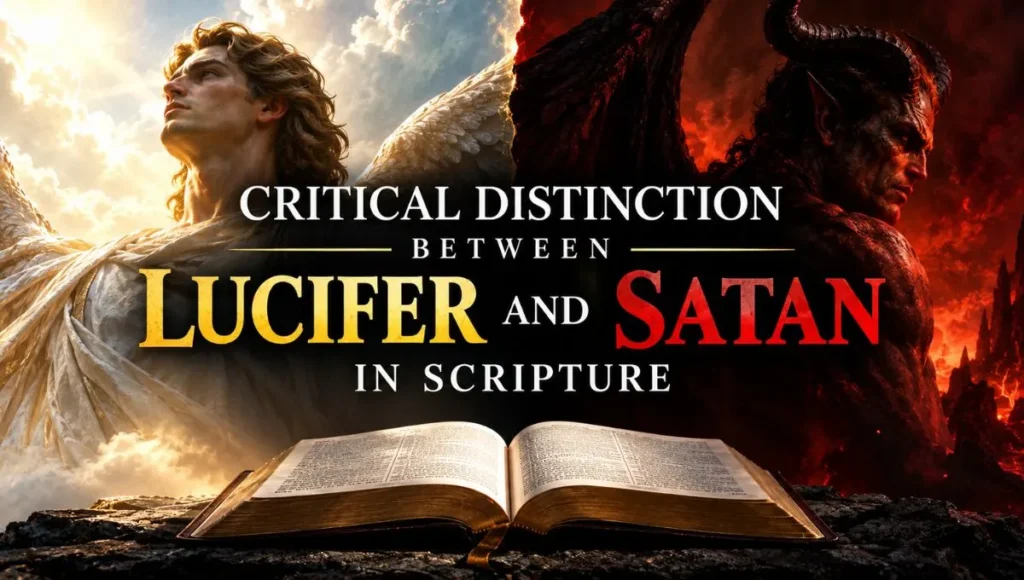
Critical Distinction Between Lucifer and Satan in Scripture
Biblical Evidence Supporting Their Distinction
- Different words. Helel is a title for a shining star. Satan means “adversary.”
- Different contexts. In Job 1–2, the word appears with the article, “the satan,” which many read as a role or title. Job 1–2 contains 14 of its Old Testament uses. Zechariah 3 shows the same figure accusing the high priest.
- Isaiah 14 describes a human end. The king’s body is denied burial, and the dead in Sheol ask, “Is this the man who made the earth tremble?” (14:16). Worms cover him (14:11).
- No New Testament link by name. No New Testament writer quotes Isaiah 14:12 as being about Satan.
How Christian Tradition Merged These Figures
Early church writers linked Isaiah 14 with Luke 10:18 (“I saw Satan fall like lightning”) and Revelation 12. Alden notes that Tertullian and Origen identified “Lucifer” with Satan. IVP’s Bible Background materials add Gregory the Great and the medieval scholastics.
Latin usage then spread the habit. Once Jerome’s lucifer became a name in English, Milton’s Paradise Lost (1667) fixed it in the public imagination.
Protestant Reformers’ Rejection of the Equation
John Calvin wrote that the Satan interpretation of Isaiah 14:12 arose from ignorance, since the context points to the king of Babylon. The Baptist commentator John Gill (1697–1771) also applied the passage to the king of Babylon, and extended it to the Roman papacy rather than to Satan.
Not all conservative scholars agree. Some hold that the king of Babylon is a type, so the passage looks past him to Satan. Pastor and commentator David Guzik reads it as both a taunt against the king and a prophecy about Satan’s destiny.
Why This Theological Distinction Matters Today
- Faithful reading. It respects the literary and historical context of the passage.
- Clear doctrine. Beliefs about Satan’s origin should rest on texts that actually teach it, such as Luke 10:18, John 8:44, and Revelation 12.
- Humility. It reminds readers that popular tradition and Scripture are not always the same thing.
Read Also: 52 Beautiful Forearm Half Sleeve Bible Verse Tattoos
Biblically Accurate Account of Lucifer’s Fall and Significance
The Narrative of the Fallen Angel in Scripture
The traditional “fall” story is assembled from several passages:
- Isaiah 14:12–15: pride and a fall from a height.
- Ezekiel 28:12–17: a perfect cherub corrupted by pride.
- Luke 10:18: Jesus sees Satan fall like lightning.
- Revelation 12:7–9: war in heaven and the dragon thrown down.
Each passage has its own context, so the story is a synthesis rather than a single narrative. Isaiah 14 and Ezekiel 28 both address human kings. Christians who apply them to Satan do so by analogy or double reference, not because the texts name him.
Lucifer’s Five “I Will” Declarations of Pride
Isaiah 14:13–14 lists five boasts:
- I will ascend to heaven.
- I will raise my throne above the stars of God.
- I will sit on the mount of assembly in the far north.
- I will ascend above the tops of the clouds.
- I will make myself like the Most High.
Some scholars compare the language with a Canaanite tale of a minor god who tried to take Baal’s throne. IVP’s materials say it cannot be decided which story came first.
The Nature of Sin: Pride in God-Given Perfection
Ezekiel 28:17 ties the fall to pride in beauty and splendor. The gifts were real, but the heart turned them into a source of self-importance. Paul gives a similar warning about leaders in 1 Timothy 3:6.
Catastrophic Consequences of Angelic Rebellion
The consequences described are public and total:
- Cast down from the height (Isaiah 14:12; Ezekiel 28:16)
- Brought down to Sheol (Isaiah 14:15)
- Mocked by those who see him (Isaiah 14:16)
- Eternal fire prepared for the devil and his angels (Matthew 25:41)
The Scope of Rebellion: One-Third of Angels
Revelation 12:4 says the dragon’s tail swept away a third of the stars of heaven. Verse 9 names the dragon as the ancient serpent, the devil, and Satan. Many interpreters read the stars as angels. This detail comes from Revelation, not Isaiah.
Artistic Evolution of Lucifer’s Image Throughout History
| Period | Typical Image |
| 6th century | Blue angel (Ravenna) |
| 13th century | Horned, clawed figure (Codex Gigas) |
| Early 14th century | Winged, frozen giant (Dante) |
| 17th century | Heroic rebel (Milton) |
| 19th century onward | Red stage devil |
Early Medieval Period: The Ethereal Blue Angel
In the 6th-century mosaic of Sant’Apollinare Nuovo in Ravenna, Christ separates the sheep from the goats. A red angel stands near the sheep, and a blue angel stands beside the goats.
Many art historians consider the blue angel the earliest surviving depiction of Satan, though some say only “may be.” The figure still looks like an angel, which fits the idea that evil began as corruption of something created good.
High Medieval Transformation to Grotesque Forms
By the 13th century, the image had turned monstrous. The Codex Gigas (“Giant Book”), made in Bohemia and now in the National Library of Sweden, has a full-page devil with red horns and claws.
It faces a page showing the heavenly kingdom. Legend says a monk wrote it in one night with the devil’s help.
Dante’s Inferno (early 14th century) shows Lucifer frozen in ice to his chest. He has three faces, six bat-like wings, and six weeping eyes, and the wind from his wings freezes the lake of Cocytus. This is where the bat wing comes from, not from Scripture.
Renaissance Romanticization: Milton’s Tragic Rebel
In Paradise Lost (1667), Milton gave Satan dignity, eloquence, and defiance. His line “Better to reign in Hell, than serve in Heaven” made Satan an anti-hero for many readers. Later illustrators, including William Blake and Gustave Doré, drew on that heroic image.
Victorian Era Through Modern: The Theatrical Red Devil
The red costume comes largely from the stage. Gounod’s opera Faust (1859) gave Mephistopheles a red costume, and the look spread through theatre and popular culture. It later became the familiar Halloween devil.
Contrasts Between Artistic and Biblical Portrayals
| Biblical text | Artistic tradition |
| Beauty, wisdom, splendor (Ezekiel 28) | Monstrous or heroic bodies |
| Pride as the root problem | Horns, tails, and fire |
| Cherubim with faces and wings | Bat wings |
| Spiritual opposition (Ephesians 6:12) | Physical creature |
Lucifer’s Role in Biblical Prophecy and Spiritual Warfare
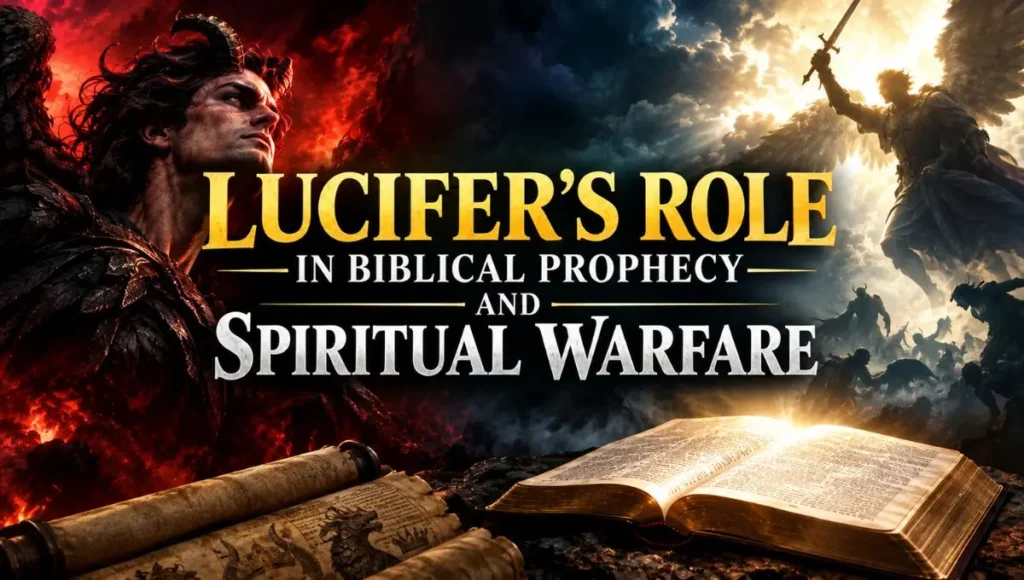
Whatever one decides about Isaiah 14 and Ezekiel 28, the New Testament is clear about the adversary’s work. He tempts (Matthew 4:1–11), accuses (Revelation 12:10), deceives (2 Corinthians 11:14), and prowls like a roaring lion (1 Peter 5:8). His defeat is certain (Revelation 20:10).
Believers are told to stand firm in spiritual warfare using God’s armor (Ephesians 6:10–18). The focus is on Christ’s victory, not on fear of a monster.
Theological Insights from a Biblically Accurate Lucifer
Three insights stand out whether the passages are read as direct, typological, or both:
- Created beauty and power are gifts, not possessions.
- Pride is the root of rebellion in angels and in kings.
- God’s judgment on arrogant rulers shows he opposes all self-exaltation.
Read Also: 51 Bible Verses About Baseball and God’s Lessons in the Game
Biblical Lessons from Lucifer’s Rebellion and Judgment
The Paradox of Created Perfection and Free Will
A good creation can still choose wrongly. Christian theology holds that real love and worship require real freedom, even though that freedom carries risk.
The Origin of Evil Within a Perfect Being
Ezekiel 28:15 says wickedness “was found” in this figure, which many read as corruption arising from within. Evil in this view is a distortion of good, not a created substance.
Pride’s Specific Temptation: Giftedness and Position
The temptation is to treat talent, rank, or closeness to sacred things as proof of deserving more. The antidote in Scripture is humility (Romans 12:3; Proverbs 16:18).
Cosmic Implications: Corrupting Others and Spiritual Warfare
Revelation 12 portrays rebellion spreading: a third of the stars follow the dragon. Rebellion rarely stays private. Pride draws others into harm.
Lessons for Humanity: Humility and Dependence on God
Jesus describes the alternative in Philippians 2:5–11, where he empties himself rather than grasping at equality with God. Greatness in the Bible comes through humility, not self-promotion.
Frequently Asked Questions
Is Lucifer the same person as Satan?
Christian tradition says yes, but the Bible never says so. “Lucifer” is a Latin rendering of helel in Isaiah 14:12, a taunt against Babylon’s king.
What does Lucifer actually look like according to the Bible?
Scripture gives no physical description of him. Ezekiel 28 describes a bejeweled guardian cherub, but the passage is addressed to the king of Tyre.
What does the name “Lucifer” mean?
It is Latin for “light-bearer,” a name for the morning star. It translates Hebrew helel, “shining one.”
Why did Lucifer fall from heaven?
Tradition points to pride (Ezekiel 28:17; Isaiah 14:13–14). The texts themselves address earthly kings, so this is a traditional reading.
How many angels fell with Lucifer?
Revelation 12:4 says a third of the stars were swept down. Many read the stars as angels.
Did Lucifer have wings?
The Bible does not say. Cherubim have wings in Ezekiel 10, but “bat wings” come from Dante.
What was Lucifer’s role before he fell?
Ezekiel 28 calls its subject an anointed guardian cherub. Whether that figure is Satan or a poetic image of a king is debated.
Is the serpent in Genesis the same as Lucifer?
Genesis 3 never names Satan. Revelation 12:9 later calls the devil the “ancient serpent.”
Can Lucifer repent and return to heaven?
Scripture gives no such offer. Matthew 25:41 speaks of fire prepared for the devil and his angels.
What is the difference between Lucifer and the devil?
“Devil” (diabolos) is a New Testament title meaning “slanderer.” “Lucifer” is a Latin star name for Isaiah 14:12.
Why does the King James Bible use “Lucifer” while other translations don’t?
The KJV followed Jerome’s Latin Vulgate and kept the Latin name. Most modern versions translate helel as “morning star” or “Day Star.”
What are the “fiery stones” mentioned in Ezekiel 28?
They are part of the mountain-of-God and Eden imagery. The text does not define them, and scholars debate the picture.
What does “morning star” symbolize in Isaiah 14:12?
It is Venus, bright at dawn and gone by sunrise. Isaiah uses it to mock a king whose glory was brief.
Conclusion
The biblical picture of Lucifer is smaller and more interesting than the popular one. “Lucifer” is a Latin star name in a single verse, a taunt against Babylon’s king. Ezekiel’s cherub is a lament over Tyre’s king, and the Bible’s titles for the adversary are Satan, the devil, and the accuser.
Many Christians still read Isaiah 14 and Ezekiel 28 as echoes of an angelic fall. That reading is a tradition built from several passages, not a single explicit statement. The clear lesson in all of them is that pride ends in ruin, and that humility is the way back.